
StableChain USDT-Native L1 Mainnet: Partners Building Payments and DeFi on Chain

StableChain’s mainnet launch on December 8,2025, ushers in a new era for USDT native L1 blockchains, specifically engineered for high-volume payments and DeFi applications. By designating USDT as the native gas token, this Bitfinex- and Tether-backed Layer 1 eliminates the volatility risks associated with traditional dual-token models, where users must acquire speculative governance tokens just to pay fees. This design delivers low, stable transaction costs, making it a compelling choice for real-world stablecoin settlements and remittances.


The network’s appeal is evident from its pre-deposit campaign, which drew over $2 billion from more than 24,000 wallets earlier in 2025. This strong early traction underscores demand for dedicated infrastructure tailored to stablecoins, particularly Tether’s dominant USDT. StableChain positions itself as a stablecoin payments blockchain, prioritizing seamless liquidity and minimal friction in decentralized finance.
USDT-Native Architecture: Core Innovations Driving Adoption
At the heart of StableChain lies its USDT-native design, a deliberate departure from generalized smart contract platforms. Transactions settle using USDT exclusively for gas, ensuring fees remain pegged to the dollar rather than fluctuating with a separate token’s market price. This innovation addresses a persistent pain point in DeFi: unpredictable costs that deter institutional and retail users alike.
The Stable Foundation, established alongside the mainnet, governs protocol upgrades, ecosystem grants, and community initiatives. Its native STABLE token facilitates staking for network security and voting on key decisions, creating aligned incentives without compromising fee stability. For investors and traders on platforms like Optimism or Arbitrum, this model echoes the efficiency of chain-native stables but scales it to a full Layer 1 optimized for payments.
StableChain vs Traditional L1s
| Feature | StableChain | Ethereum/Base |
|---|---|---|
| Gas Token | USDT | Native volatile |
| TVL Potential | High for payments | Lower general |
| Fee Predictability | Stable | Volatile |
Strategic Partnerships Accelerating Payments and DeFi Ecosystems
StableChain’s mainnet rollout coincides with high-profile collaborations that bridge traditional finance and crypto. PayPal’s partnership, highlighted by PayPal Ventures’ investment, integrates StableChain into its payment rails, enabling instant USDT settlements for merchants and users worldwide. Anchorage Digital joins as a custody partner, while Standard Chartered’s Libeara tokenization platform leverages the chain for real-world asset (RWA) deployments.
StableChain Key Partners
-
PayPal: Payment integrations and backed by PayPal Ventures investment for USDT-native payments.
-
Anchorage Digital: Institutional custody solutions for secure asset management on-chain.
-

Libeara (Standard Chartered): RWA tokenization platform enabling real-world asset integration.
-
Curve Finance: DEX liquidity provision optimized for stablecoin trading on StableChain.
-

Transak: Fiat onramps for seamless USDT deposits and user onboarding.
These alliances extend to DeFi primitives like Curve Finance for efficient stablecoin swaps and Transak for seamless fiat-to-USDT entry points. Orbital and Oobit further enhance payment orchestration, positioning StableChain as a chain native USDT settlements hub. Early backers, including a $28 million seed round led by Bitfinex and Hack VC, signal confidence in its long-term viability.
From a risk assessment perspective, this ecosystem buildout mitigates common stablecoin pitfalls. Peg stability remains paramount, as USDT’s proven track record on StableChain reduces bridging needs and associated costs. For DeFi enthusiasts navigating L2s, StableChain offers a mainnet alternative with superior payment throughput, potentially capturing flows from cross-chain stable transfers.
Implications for Chain-Native Stablecoin Strategies
StableChain redefines StableChain partners DeFi dynamics by embedding USDT directly into its consensus layer. Stakers earn yields on STABLE while securing a network fueled by the world’s largest stablecoin, creating a symbiotic relationship. This contrasts with L2 stable assets, where fragmentation across chains dilutes liquidity; here, everything converges on one USDT-powered rail.
Traders optimizing for real-world stablecoin rail applications will find StableChain’s throughput particularly advantageous, with block times tuned for sub-second confirmations on payment volumes exceeding millions of USDT daily. This setup not only slashes latency but also bolsters composability for DeFi protocols layered atop it, from lending markets to perpetuals settled in native USDT.
STABLE Tokenomics: Balancing Security and Growth
| Category | Allocation % | Vesting Period | Utility |
|---|---|---|---|
| Liquidity Bootstrapping 📈 | 20% | Immediate | DEX pools |
| Foundation Reserves 🔒 | 25% | 4-year cliff/vest | Development |
| Community Rewards 📈 | 30% | Ongoing emissions | Airdrops & incentives |
| Validators/Staking 🔒💰 | 15% | Locked | PoS security & USDT fee yields |
| Ecosystem Grants 📈 | 10% | Milestone-based | dApps & partners |
| Total | 100% | Total Supply 1B STABLE, Gas in USDT preserved |
Yet, success hinges on developer adoption. Initial grants from the Stable Foundation prioritize payment dApps, RWAs, and cross-border ramps, fostering a flywheel where more apps attract deeper USDT liquidity. Partners like WalletConnect streamline wallet integrations, easing entry for non-crypto natives reliant on predictable costs.
StableChain Risk Factors and Mitigations
| Risk | Description | Mitigation |
|---|---|---|
| Centralization | Tether/Bitfinex incubation concerns | Foundation independence & decentralization roadmap ✅ |
| USDT Reserves | Historical scrutiny over reserves | On-chain transparency tooling 📊 |
| Regulatory | SEC/EU MiCA oversight for payments L1 | Compliance via partners like PayPal ⚖️ |
| Peg/Liquidity | Volatility & bootstraps | STABLE dual-token absorbs volatility, $2B pre-deposits 💰 |
| Technical | Bridge-less but oracle deps for RWAs | High fee predictability, vigilant monitoring 🔍 |

Traditional savings lose to inflation.
Pure crypto is feast or famine.
Mantle Vault lives in the middle.
institutional grade stablecoin yield made retail accessible.
As RWAs, AI driven strategies, & multichain liquidity expand on Mantle, this https://t.co/Rrna84dMZg

Mantle Vault is designed for users who want stable, predictable returns without active management.
It’s suitable for ↓
→ Stablecoin holders seeking passive income above standard savings rates
→ Users who value capital preservation over https://t.co/aicxkeA8cy

→ Users who want instant liquidity
→ Active day traders who may need funds quickly for margin calls
→ Anyone uncomfortable with a 2–3 day redemption period. https://t.co/LDfxqSjvVY

→ Go to Bybit On Chain Earn
Visit the Bybit homepage, open the Earn tab in the navigation bar, and select On Chain Earn.
→ Select Mantle Vault
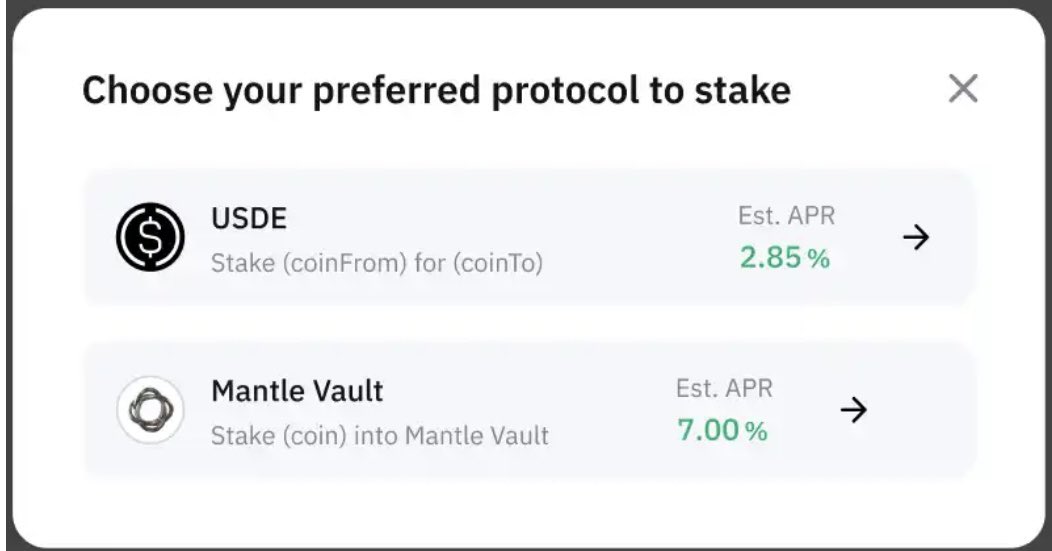
Browse the eligible assets & choose USDT or USDC. Click Stake Now, then select Mantle Vault from https://t.co/oQT5U2RFYK

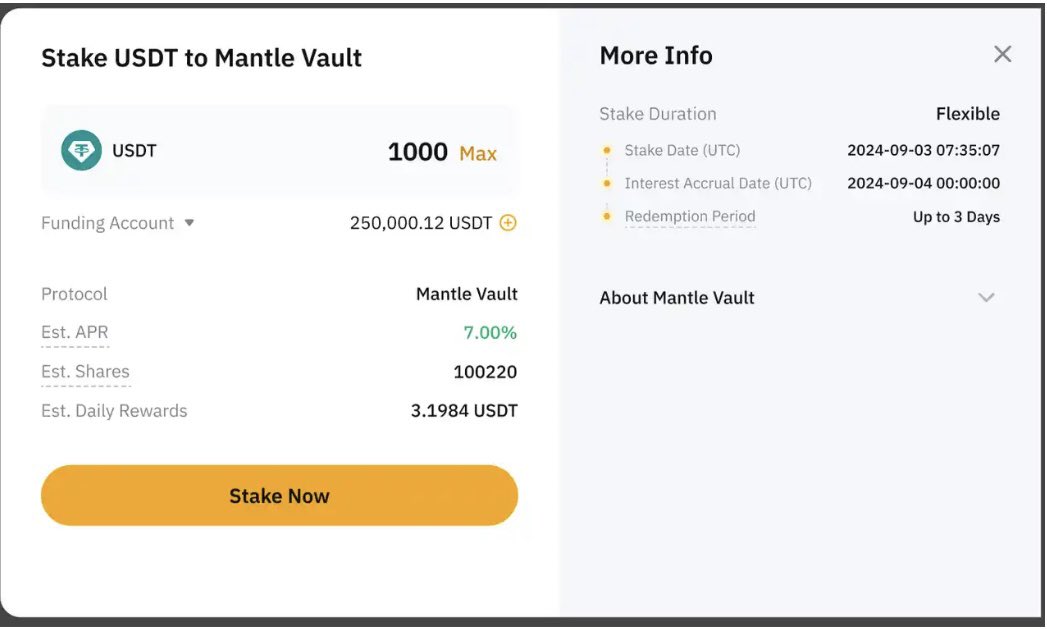
On the staking page, input the amount you wish to subscribe. Review the product details & terms carefully, then confirm by clicking Stake Now.
→ Start Earning
Once confirmed, your funds are deployed on-chain and you’ll begin earning the target https://t.co/XwBcAUYgAt
It mainly uses ➤
→ Direct stablecoin lending on Aave
→ USDe strategy [ Ethena synthetic dollar ]
→ Controlled looping to increase efficiency
It dynamically balances ➤
→ Higher yield strategy [ USDe ]
→ Higher liquidity strategy [ https://t.co/Uec1lhBfKr

→ Downloag bybit
→ Buy some USDT/USDC
→ stake it on mantle’s vault
→ earn yield from your staked stables. https://t.co/tvxC02EILM

It’s not revolutionary tech.
It’s revolutionary access.
Deposit idle stables.
Let professionals run the strategies.
Get paid to waitwhether the https://t.co/rraK53KErN

→ Mantle Network: @Mantle_Official | https://t.co/Bnweb616LF
→ Bybit: @Bybit_Official | https://t.co/KLZL8V8xKv
→ CIAN: @CIAN_protocol
If your stables are still sleeping… maybe it’s time to wake them up.
What are you parking yours in https://t.co/QFi0LFkZim

Strategic positioning favors institutions eyeing tokenized treasuries or remittance corridors. Libeara’s RWA integrations, for instance, could pipe real-world yields into USDT liquidity pools, blending TradFi efficiency with DeFi composability.
[h2 class=”subheading has-parts”]Outlook for USDT Native L1 Dominance
StableChain arrives at a inflection point for stablecoin payments blockchain infrastructure, where generalized L1s falter under volatile fees and L2s grapple with sequencer risks. By laser-focusing on USDT, it carves a niche for high-frequency, low-drama settlements, potentially siphoning volumes from Ethereum bridges or Solana’s meme-driven volatility. PayPal’s endorsement validates this trajectory, hinting at broader fiat gateways that could eclipse legacy rails like SWIFT for emerging markets.
For DeFi traders, the playbook shifts toward STABLE staking paired with USDT perps or Curve pools, harvesting dual yields in a stable fee regime. As ecosystem grants roll out, watch for DEXs and lending protocols that exploit native gas for micro-transactions, unlocking use cases from payroll to micropayments. In volatile markets, this USDT-powered bedrock promises resilience, rewarding those who prioritize infrastructure over hype.
Read more on how this fits into broader trends at DeFi Coverage and Stablecoin Flows.